The Five Pillars of a Smooth Plastic Surgery Recovery

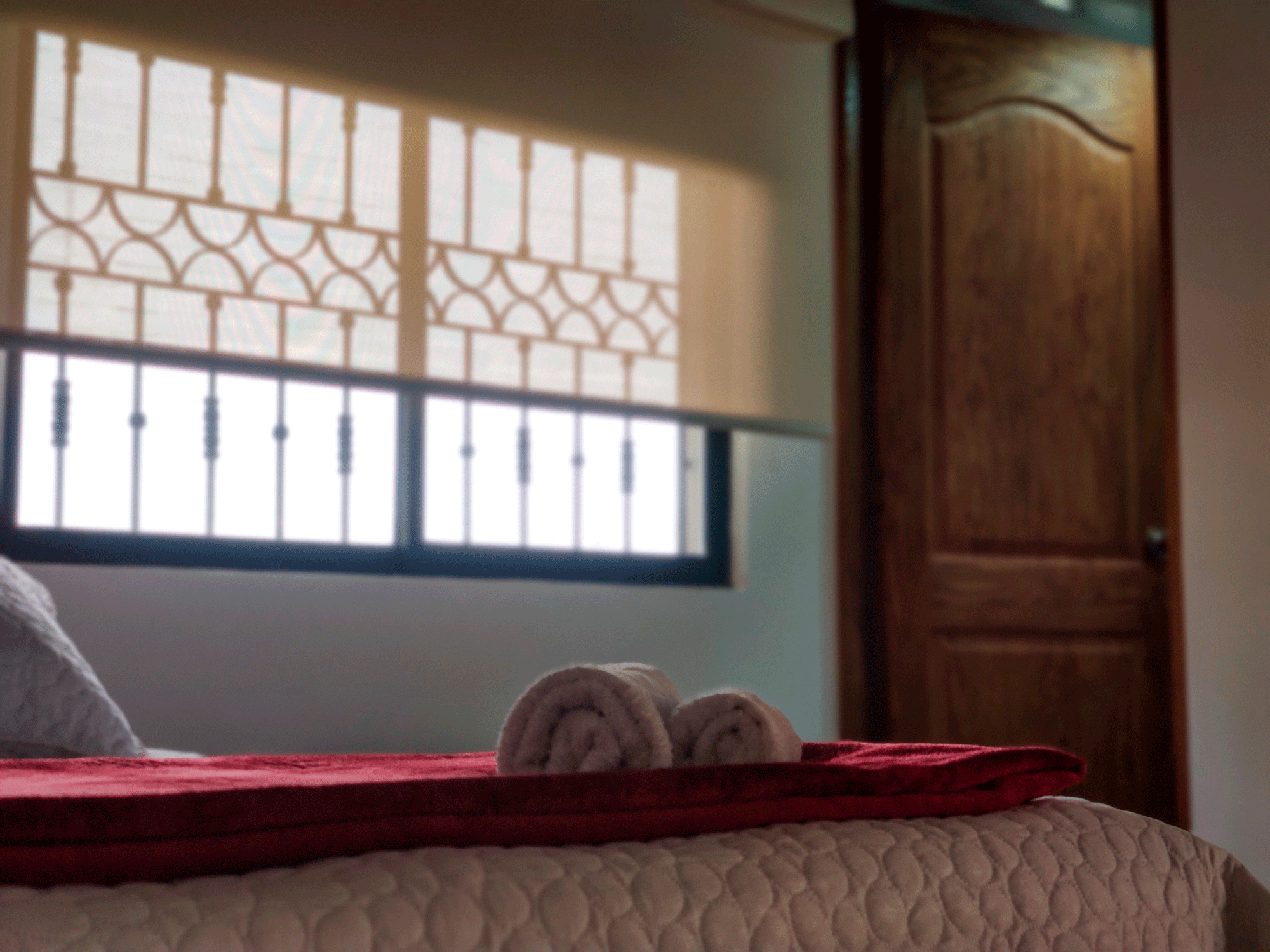
After more than seven years of welcoming patients from all over the world into Recovery House Medellín, we've noticed something. The patients who heal smoothly — who feel more like themselves at week three than they ever expected — share five things in common. None of them are random.
We call them the five pillars of recovery. When all five are in place, the body does its work and the mind stays calm. When even one is missing, recovery still happens, but it feels harder and slower than it should. These are the plastic surgery recovery essentials we build every patient's stay around.
Pillar One: Sleep — Where the Real Healing Happens
You've heard it your whole life: sleep is when the body repairs itself. After surgery, that's not a saying. It's mechanically true.
Most of your tissue rebuild — the new collagen, the new capillaries — happens during deep, slow-wave sleep, mostly between 11 p.m. and 4 a.m. Patients who sleep poorly during recovery often see more swelling, slower bruise resolution, and a higher chance of complications.
The challenge after surgery is that sleep is hard. You can't lie in your usual position. Pain wakes you. Anxiety wakes you. Hospital noise wakes you.
Our recovery house is built for this. Every suite is dim, quiet, and temperature-controlled. We provide angled wedges, body pillows, and the specific positioning needed for each procedure — knees-up after a tummy tuck, head-elevated after rhinoplasty, chest-elevated after a BBL. Our nurses time pain medication so you don't wake at 3 a.m. wishing for relief.
Your job during the first week is to sleep. Ours is to make that simple.
Pillar Two: Nutrition — Fuel for Tissue Rebuild
When your body is rebuilding tissue, it needs more protein, more vitamin C, and more zinc than it usually does. Not in a "drink three smoothies a day" way. In a "your skin literally cannot close without these" way.
We design every meal in our recovery house around three principles. High protein — at least 90 to 120 grams a day, scaled to your weight and procedure. Anti-inflammatory ingredients — turmeric, ginger, dark berries, salmon, leafy greens. Comfort — because food you don't want to eat doesn't help anyone.
Our menu draws on Colombian flavors patients already love. Sancocho de pollo on cool evenings. Arepas with eggs in the morning. Fresh papaya, pineapple, and passion fruit at every meal. Bone broths that taste like a grandmother made them.
You won't be on a "diet." You'll be eating food that happens to be exactly what your body needs.
Pillar Three: Gentle Movement — Less Risk, Faster Healing
This is the pillar most patients underestimate. After surgery, the instinct is to lie still. Stillness feels safe. It isn't.
Lying completely still for more than four to six hours significantly raises your risk of blood clots, especially after longer procedures. Gentle movement — even just walking from your bed to the garden — lowers that risk dramatically and accelerates healing.
The trick is the word "gentle." We're not talking about workouts. We're talking about 200 steps on day one. 500 by day three. A loop around the garden by day five. Our nurses walk with you the first time. We have handrails, soft floors, and a courtyard designed for this exact purpose.
You don't have to be motivated. You just have to show up at the door of your suite. We do the rest.
Pillar Four: Human Support — Presence as Medicine
Recovery is lonely if you're alone with it. Even patients who travel with a partner feel it — the long quiet hours when you're awake, and they're not, the small worries that grow at 2 a.m.
Our recovery house is staffed by professional nurses. They're trained in plastic surgery aftercare specifically — not general nursing — so they recognize what's normal and what isn't. They check in on you without being asked. They sit with you when you want company. They leave you alone when you don't.
Other patients become part of this too. Our communal areas — the kitchen, the garden, the reading nook — let you meet other people going through the same thing. A breakfast conversation with someone three days ahead of you in their recovery is its own kind of medicine.
You're not alone with this. That's the point.
Pillar Five: Mindset — Patience as a Skill
The last pillar is the hardest to deliver and the most important. Plastic surgery recovery has a strange emotional shape. Day one, relief. Day three to five, what we call the post-op blues — almost universal, almost always fades by day seven. Week two, impatience. Week four, the first glimpse of the new you.
Knowing this curve in advance changes everything. When the day-three blues hit, you don't panic — you recognize them and rest through them. When week-two impatience hits, you trust that swelling will keep improving for months.
Our recovery coach checks in with every patient during the emotional dips. Sometimes that means a conversation. Sometimes a walk. Sometimes it just means knowing you're not strange or broken — you're exactly where you should be.
Patience is a skill. We help you build it.
How the Five Pillars Work Together
These pillars aren't a checklist. They reinforce each other.
Sleep makes the food do more. Food gives you energy to walk. Walking helps you sleep. Support steadies your mindset. Mindset lets you rest without anxiety. Rest leads back to sleep.
Pull one pillar out and the whole structure leans. That's why we don't ask patients to "manage" their own recovery. We build the entire environment around all five pillars at once.
What Recovery Looks Like Here
A typical day begins with a quiet wake-up around 8 a.m. — never abrupt. A high-protein breakfast you'll actually look forward to. A nurse check-in with vital signs and dressing review. A morning walk in the garden when you're ready. Lymphatic drainage massage for patients whose surgery calls for it. A nap. A meal. A conversation with another patient. Another nap. Dinner. Sleep.
It's intentionally simple. Healing doesn't need complexity. It needs the right pillars, in the right order, every day.
Your Recovery, Built Around You
If you're researching where to recover after plastic surgery, the question isn't "where can I sleep?" It's "where will all five plastic surgery recovery essentials actually be in place?" That's the difference between a recovery that feels like a marathon and one that feels like a retreat.
Contact us, and we'll walk you through what your specific procedure's recovery looks like in our house — meals, nursing care, suite type, day-by-day rhythm. No pressure, just answers.

Comments